
Why Are Custom Sticky Notepads Commonly Included in Corporate Stationery Programs?
2026-11-12
A procurement manager reviews the annual stationery budget and notices a pattern. Toner, paper, and pens consume most of the spend, but the item that employees ask for most often is the Sticky Note. The request is not driven by a special project. It is driven by daily use: marking documents, leaving reminders on desks, flagging pages in manuals, and leaving messages for colleagues. The same manager also notices that the branded notes placed in meeting rooms are used, photographed, and carried to client sites. This combination of high usage and low unit cost is why custom Sticky Note pads appear in almost every corporate stationery program. This guide explains the procurement logic and the specifications that matter.
1. Why Does a Low-Cost Item Like a Sticky Note Earn a Place in the Annual Stationery Budget?
The annual stationery budget is built around items that are consumed continuously, not items that are used once. A Sticky Note is consumed daily in almost every department, and the consumption is predictable. It is also an item that employees will take without a special request, which means it is used rather than stored. From a budget perspective, the unit cost is low enough that it does not require a separate approval, but the total volume is high enough that it deserves a framework agreement. In our factory, we supply custom pads to corporate stationery programs and we see the same pattern across industries: the note is ordered in large quantities, in a small number of standard sizes, and with a consistent print layout. Ningbo Sentu Art And Craft Co., Ltd. has been producing custom stationery for over 10 years.
The budget case is stronger when the item carries the company logo. A plain note is a commodity. A branded note is a communication tool that appears on desks, in meeting rooms, and in client files. The cost per impression is very low, and the impression is repeated every day. Our factory produces pads with single-color logos for internal use and multi-color layouts for client-facing programs.
2. Which Customization Options Fit Different Corporate Stationery Programs?
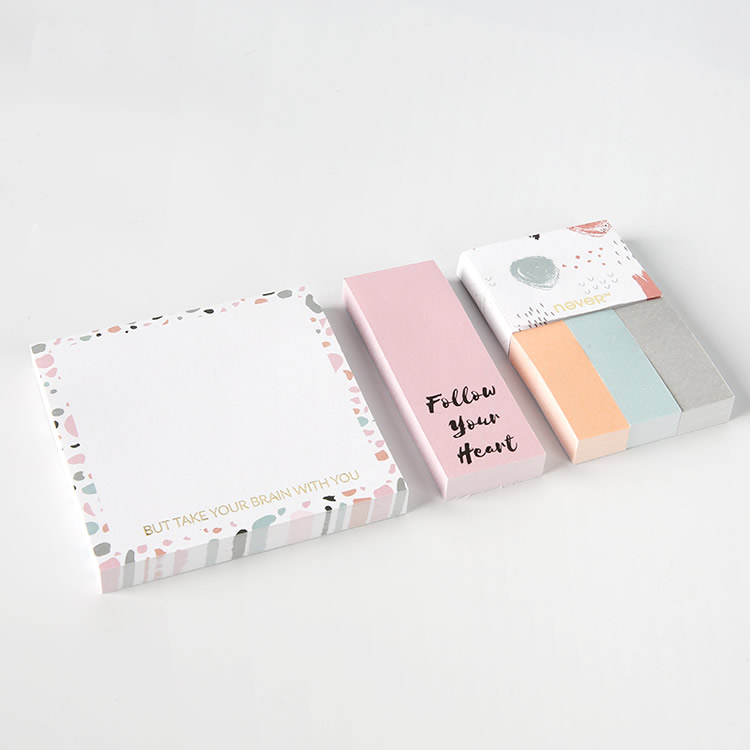
The customization options for a Sticky Note range from a simple one-color logo to a fully custom die-cut shape with a printed cover. The choice depends on the audience, the distribution channel, and the budget. An internal program usually needs a standard size, a one-color logo, and a low unit cost. A client-facing program may need a larger size, a multi-color print, and a cover that carries a campaign message. The table below compares the common options and their procurement parameters.
| Customization option | Minimum order quantity | Typical lead time | Cost impact | Best fit |
| One-color pad print | 5,000 pads | 10 to 15 days | Low | Internal stationery, general office use |
| Two-color offset print | 10,000 pads | 15 to 20 days | Moderate | Department programs, client-facing use |
| Custom die-cut shape | 20,000 pads | 20 to 30 days | High | Events, campaigns, premium kits |
| Printed cover and back card | 10,000 pads | 15 to 25 days | Moderate | Welcome kits, training materials |
| Multi-pad stationery set | 3,000 sets | 20 to 25 days | Moderate to high | Executive gifts, onboarding packs |
In our factory, we recommend that the procurement team select two standard sizes for the internal program and one premium option for client-facing use. This keeps the inventory simple and the reorder process predictable. We also provide a print proof and a physical sample before the production run so that the logo position and the color match can be approved. Ningbo Sentu Art And Craft Co., Ltd. keeps the approved artwork and the paper specification on file so that the reorder is identical to the first order.
3. How Do Paper, Adhesive, and Packaging Specifications Affect Daily Office Use?
The paper and adhesive specifications determine whether the note works in daily use. A paper that is too thin curls at the edge and does not lie flat. A paper that is too thick does not adhere well and uses more space in the pad. The adhesive must be strong enough to hold the note on a monitor or a document but removable enough to leave no residue. The packaging determines how the pads are stored and distributed. The table below shows the common specifications and their effect on office use.
| Specification | Writing experience | Adhesion behavior | Typical office use | Relative cost |
| 70 gsm uncoated paper | Light, ballpoint only | Standard removable | General reminders, page flags | Low |
| 80 gsm uncoated paper | Smooth, ballpoint and gel | Standard removable | Meeting notes, desk reminders | Low to moderate |
| 100 gsm uncoated paper | Firm, fountain pen friendly | Strong removable | Client-facing notes, training | Moderate |
| Standard removable adhesive | Not applicable | Holds for 24 to 48 hours, clean removal | Monitors, documents, walls | Baseline |
| Strong removable adhesive | Not applicable | Holds for 7 days, clean removal | Whiteboards, glass, displays | Moderate |
Procurement manager's note: The adhesive is the specification that generates the most complaints. A note that leaves residue on a monitor or a document creates more work than the note saves. In our factory, we test the adhesive on glass, painted metal, and paper before the production run. The note must hold for the specified time and must remove without leaving a mark. Sentu provides the adhesive test result with each batch and recommends the standard removable adhesive for general office use and the strong removable adhesive only for whiteboard and glass applications.
4. Why Does a Custom Sticky Note Support Brand Visibility Better Than Many Other Giveaways?
Many promotional items are used once and then discarded. A custom Sticky Note is used repeatedly, and it stays visible on the desk or the monitor for hours or days. The visibility is passive, which means the brand is seen without an active promotion. The note is also a working tool, so employees keep it within reach rather than storing it in a drawer. In our factory, we see that the branded note is one of the few giveaway items that employees request again when the supply runs out. This repeat request is the clearest signal that the item has value in daily work. Our factory produces pads with a light background and a small logo so that the note remains usable for writing, not just for display.
The brand visibility is strongest when the print is subtle. A note that is covered with a large logo is less likely to be used for a quick reminder. A note with a small logo in the corner is used every day, and the logo is seen every day. We recommend a logo size that occupies no more than 15 percent of the note area for internal use, and up to 25 percent for client-facing use.
5. How Should Procurement Teams Verify Quality and Delivery Before Reordering?
The reorder should be based on a documented specification, not on a sample from the first order. The specification should include the paper grammage, the sheet size, the adhesive type, the print colors, the logo position, the pad count, and the packaging. The verification should include three checks. The first is a dimensional check of the sheet size and the pad count. The second is an adhesive check on a sample from the new batch. The third is a color check against the approved proof. In our factory, we keep the approved proof and the paper specification on file for each customer, and we compare every reorder against the file. Ningbo Sentu Art And Craft Co., Ltd. provides a batch record and a pre-shipment sample for each reorder so that the procurement team can confirm the match before the full shipment is released.
The delivery verification is equally important. The stationery program usually has a fixed distribution date, and a late delivery disrupts the distribution. The purchase order should state the required delivery date and the acceptable lead time. Our factory provides a production schedule at the time of order and a shipping notice when the goods leave the factory. For repeat programs, we recommend keeping a safety stock of two months of consumption so that a short delay does not stop the distribution.
Frequently Asked Questions About Custom Sticky Notepads in Corporate Stationery Programs
The custom Sticky Note is a small item with a large operational footprint. It is consumed daily, it carries the brand into meetings and client files, and it is inexpensive enough to include in the standard stationery program without a separate approval. The procurement decision should be based on a documented specification: paper grammage, sheet size, adhesive type, print method, logo position, pad count, and packaging. The reorder should be verified against the approved proof and the batch record, and the delivery should be planned with a safety stock. When these controls are in place, the custom note becomes a reliable part of the stationery program rather than a recurring source of complaints.