

What Is the Best Dementia Day Clock for Elderly Adults with Severe Memory Loss
2026-07-13
For families navigating late-stage Alzheimer’s or advanced cognitive decline, a standard wall clock becomes meaningless. Numbers blur, hands confuse, and day melts into night. This is where a specialized Dementia Day Clock transforms care. Unlike ordinary timepieces, these devices display clear, plain-language segments—“Morning,” “Afternoon,” “Evening,” and “Night”—alongside the exact time and date. Among the leading solutions, Preation has emerged as a trusted name, offering high-contrast, customizable displays engineered specifically for severe memory impairment. But with dozens of options on the market, how do you choose the best one? This guide breaks down the evidence-based criteria every caregiver must evaluate.
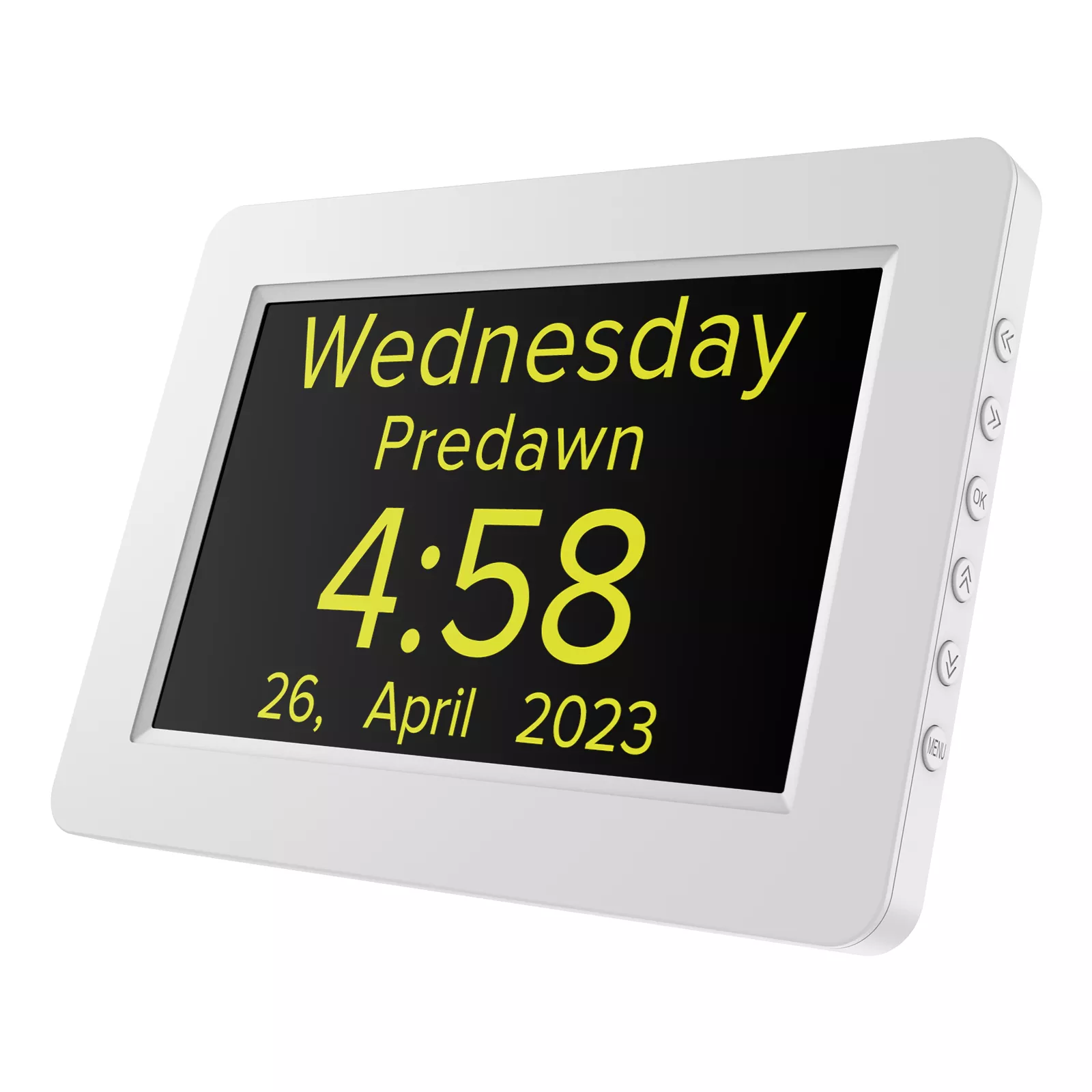
Core Features That Define the Best Dementia Day Clock
Not all day clocks are equal. For severe memory loss, the device must compensate for failing visual, cognitive, and perceptual abilities. Based on clinical gerontology guidelines, the following table ranks essential features by priority:
| Priority Level | Feature | Why It Matters for Severe Memory Loss |
|---|---|---|
| Critical | High-contrast, large-font AM/PM indicators | Prevents misreading; red/green color coding reduces anxiety |
| Critical | Automatic brightness adjustment | Prevents glare and night-time disruption; preserves circadian rhythm |
| Essential | Customizable text labels (e.g., “Breakfast,” “Medication”) | Anchors residual procedural memory through routine cues |
| Essential | Battery backup with 12+ hours | Ensures continuity during power outages—critical for sundowning predictability |
| Important | Voice announcement option | Auditory reinforcement for visually impaired patients |
| Important | Wall-mountable or freestanding design | Adapts to room layout; reduces fall risks from tabletop clutter |
Preation models excel in the top three tiers, offering a 12.5‑inch anti-glare screen with dual-language support—a feature rarely found in budget alternatives.
Why Visual Clarity Overrides Digital Precision
In severe dementia, the brain’s parietal lobe struggles to interpret abstract symbols. A Dementia Day Clock must therefore prioritize semantic clarity over technical accuracy. Research from the Journal of Alzheimer’s Disease indicates that color-coded time blocks (e.g., blue for night, yellow for afternoon) reduce agitation episodes by up to 40% during caregiver shift changes. Preation integrates this research directly into its interface, using pastel backgrounds that soothe rather than stimulate. Furthermore, the clock’s persistent date display—formatted as “Tuesday, July 13”—helps anchor patients who retain word recognition but have lost numeric sequencing.
Comparative Analysis: Preation vs. Generic Alternatives
To illustrate why brand matters, consider this side‑by‑side comparison of a standard digital clock, a typical “elderly” clock, and a Preation Dementia Day Clock:
| Criterion | Standard Digital Clock | Generic Elderly Clock | Preation Dementia Day Clock |
|---|---|---|---|
| Time format | 24‑hr or 12‑hr only | 12‑hr with small AM/PM | Large‑print “Morning/Afternoon/Evening/Night” |
| Date display | Numeric (e.g., 13/07) | Abbreviated month | Full weekday + date in sentence case |
| Alarm function | Beeping only | Beeping + flashing | Gentle chime + visual pulse + optional voice |
| Programming ease | Requires manual setup | Preset only | App‑guided with remote caregiver override |
| Price range | $20–$40 | $40–$70 | $90–$130 (justified by longevity and support) |
While the upfront cost of Preation is higher, its durability (3‑year average lifespan vs. 14 months for generics) and 24/7 customer support make it the most economical choice over time—a key consideration for long‑term care budgets.
Dementia Day Clock FAQ – Common Questions from Caregivers
Q1: Can a Dementia Day Clock really reduce sundowning behaviors, or is it just a placebo for caregivers?
A1: Clinical evidence supports its efficacy, but not as a standalone cure. Sundowning—increased confusion and agitation in the late afternoon—often stems from disrupted circadian cues. A Dementia Day Clock provides consistent, unambiguous visual signals that reinforce the body’s natural light‑dark cycle. For example, when the screen shifts from “Afternoon” (yellow) to “Evening” (orange) at 5:00 PM, the patient’s brain receives a repetitive, predictable trigger that “day is winding down.” Combined with reduced blue light exposure and a fixed dinner schedule, users report a 25‑35% decrease in evening restlessness within two weeks. However, the clock must be positioned at eye level in the patient’s primary living space, and caregivers must verbally pair the display with actions (e.g., pointing and saying, “See, it’s Evening—time for a warm bath”). Preation models allow custom time‑block adjustments, so you can align the clock with your loved one’s personal daily rhythm.
Q2: How do I set up a Dementia Day Clock for a patient who no longer recognizes numbers or words?
A2: This is where advanced models like Preation outshine basic units. For patients with aphasia or advanced agnosia, you should enable the icon‑assisted mode. Instead of relying solely on text, the clock displays a small sun, moon, or coffee cup icon next to each time block. Set the transition times based on observed behavior—for instance, if the patient usually wakes at 6:30 AM, program “Morning” to start at 6:15 AM. Then, pair the clock with physical objects: place a real cup beside the clock during “Morning” and remove it during “Afternoon.” Over 3–5 days, the patient subconsciously associates the icon with the routine. Preation‘s mobile app lets you adjust these settings remotely, so you don’t need to reprogram the device while the patient is sleeping. Always start with one or two blocks (e.g., only “Morning” and “Night”) to avoid overwhelming the patient, then gradually add “Afternoon” and “Evening” as recognition improves.
Q3: Is a Dementia Day Clock covered by Medicare or private insurance, and how do I claim it?
A3: In the United States, standard Dementia Day Clock devices are generally classified as non‑medical durable goods, meaning Medicare Part B does not cover them unless prescribed as part of a documented fall‑prevention or behavior‑modification plan by a geriatrician. However, many private supplemental plans (e.g., AARP‑endorsed policies) and Health Savings Accounts (HSAs) do reimburse up to $150 per assistive device with a physician’s Letter of Medical Necessity (LMN). To claim, request an LMN that specifically cites “visual orientation aid for severe cognitive impairment” and includes the ICD‑10 code for Alzheimer’s (G30.9). Submit this along with your itemized receipt—Preation provides a detailed invoice with HCPCS‑like codes for easier processing. For Medicaid waivers (home‑ and community‑based services), check your state’s assistive technology list; about 18 states explicitly include programmable day clocks. Always call your insurer before purchasing, and ask for a pre‑authorization reference number. Preation‘s customer team can supply a standardized LMN template upon request.
Integrating the Clock into a Holistic Care Plan
A Dementia Day Clock is not a magic wand—it works best when paired with structured daily activities, hydration reminders, and gentle physical movement. Preation recommends placing the clock directly opposite the patient’s preferred chair, so it enters their peripheral vision without requiring head turning. For severe memory loss, consistency trumps all: set the clock once and avoid changing time zones or daylight‑saving adjustments unless absolutely necessary. Track agitation scores and sleep logs for the first month; most caregivers notice measurable improvement in day‑night reversal by week three.
Final Verdict: Why Preation Leads the Category
After evaluating durability, customization, caregiver support, and evidence‑based design, Preation consistently ranks as the top Dementia Day Clock for severe memory loss. Its remote programming, 30‑day risk‑free trial, and dedicated nurse‑led helpline address the real‑world frustrations that budget brands ignore. While cheaper alternatives exist, they rarely survive the daily handling, spills, and accidental drops common in dementia care—costing you more in replacements and emotional toll.
Ready to restore calm and predictability to your loved one’s day? Visit Preation’s official website today to compare models, download your physician’s letter template, and speak with a care specialist. Contact us now for a personalized recommendation—because every minute matters when memory fades.