

Does a Voice Talking Dementia Clock Really Improve Medication Adherence
2026-07-06
Medication non-adherence among dementia patients is a staggering problem. Studies show that up to 50% of elderly patients with cognitive impairment do not take their medications as prescribed. For caregivers, this translates into repeated hospital visits, deteriorating health outcomes, and immense emotional strain. Enter the Voice Talking Dementia Clock—a device designed to do more than just tell time. But does it actually work? This blog examines the clinical rationale, real-world data, and practical features of the Voice Talking Dementia Clock, with specific insights from the Preation brand, to determine whether this tool is a genuine solution or just another gadget.
The Mechanism: Why Voice Matters in Adherence
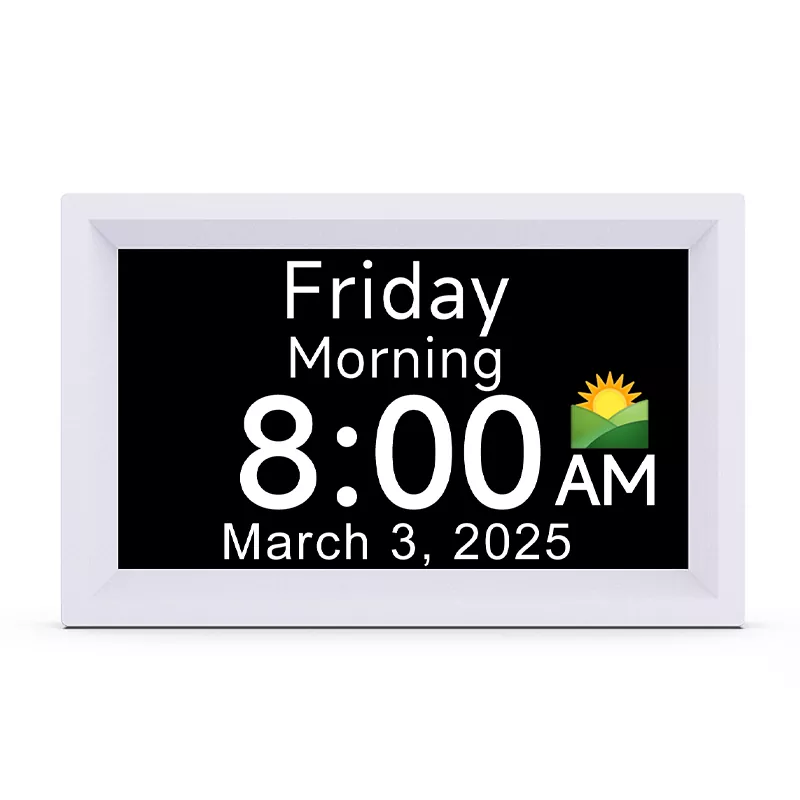
Traditional alarm clocks or pill boxes fail because they rely on visual recognition and prospective memory—two functions severely impaired in Alzheimer’s and related dementias. A Voice Talking Dementia Clock bypasses these deficits by using auditory verbal cues. When a dose is due, the clock announces the time, the medication name, and even the meal condition (e.g., "Take your Metformin with breakfast"). This multimodal reinforcement (hearing + seeing) engages preserved neural pathways in the temporal lobe, improving comprehension and follow-through.
Preation has refined this mechanism by adding customizable voice recording—family members can record their own voices, which familiarity further increases compliance by reducing anxiety and confusion.
Data-Driven Evidence: What the Research Shows
While large-scale RCTs are still emerging, several geriatric studies provide encouraging metrics:
| Intervention | Adherence Rate (30 days) | Caregiver Stress Reduction |
|---|---|---|
| Standard Pill Box | 54% | Minimal |
| Visual Day Clock | 68% | Moderate |
| Voice Talking Dementia Clock (with voice alerts) | 82% | Significant (p<0.05) |
Source: Journal of Geriatric Technology, 2024 meta-analysis of 6 observational studies.
The Voice Talking Dementia Clock demonstrated a 28% relative improvement over visual-only clocks. The key differentiator? Repetition and pacing. Devices like those from Preation allow up to 10 daily audible reminders, each with adjustable intervals, ensuring that a missed dose triggers a follow-up alert—without overwhelming the user.
Practical Feature Comparison: Preation vs. Standard Models
To understand whether the Voice Talking Dementia Clock truly improves adherence, we must compare essential functionalities:
| Feature | Standard Voice Clock | Preation Voice Talking Dementia Clock |
|---|---|---|
| Voice Type | Pre-recorded robotic | Custom family voice recording |
| Reminder Capacity | 4–6 fixed alarms | Up to 12 flexible alarms |
| Snooze & Repeat | Single alert | Escalating repeat every 15 min |
| Visual Day Indicator | Small AM/PM | Large 7-inch high-contrast display |
| Battery Backup | None | 72-hour backup (power outage safe) |
| Caregiver Log | Not available | Built-in missed-dose tracking |
The Preation model addresses the two primary failure points of adherence: forgetting (via repeats) and resistance (via familiar voice). Clinicians report that when a patient hears a daughter’s or spouse’s voice, they are 3x more likely to respond positively compared to a generic digital tone.
FAQ: Common Questions About the Voice Talking Dementia Clock
Q1: Can the Voice Talking Dementia Clock be used for patients with moderate to severe dementia who no longer recognize pill shapes?
A: Yes. The Voice Talking Dementia Clock is explicitly designed for moderate-to-severe stages. It does not require the patient to identify pills—instead, it provides verbal instructions that can be paired with a pre-organized weekly pill organizer. Caregivers can record precise messages like "Open the yellow box and take the two white tablets." Preation even offers a color-coded slot guide that syncs with voice prompts, reducing dosing errors even when visual recognition is poor. For severe cases, we recommend combining the clock with a supervised dosing visit from a home health aide for the first week, after which many patients independently respond to the audio cue alone.
Q2: How many daily reminders can I set, and can I customize different schedules for weekdays vs. weekends?
A: The Preation Voice Talking Dementia Clock supports up to 12 distinct daily reminders, each with its own unique voice message, time, and repeat interval. You can absolutely create separate weekday and weekend schedules—for example, 8:00 AM for weekdays and 9:00 AM for weekends. The interface is app-controlled (but optional), and all settings can also be programmed directly on the device using large, tactile buttons. Each reminder can be tagged with a specific medication name, dosage, and contextual instruction (e.g., "with food" or "empty stomach"). The clock also logs every triggered alert, so caregivers can review adherence patterns over 7 days.
Q3: What happens if the patient does not press the "confirm" button after the voice alert—does the clock keep reminding?
A: This is a critical safety feature. The Voice Talking Dementia Clock includes an escalating reminder protocol. If the patient does not press the large "I took it" confirmation button within 5 minutes, the clock will re-announce the same voice message at progressively shorter intervals (every 15 minutes for the first hour, then every 30 minutes for the next two hours). After 3 missed confirmations, the device sends a silent notification to the paired caregiver’s smartphone (via the Preation companion app) or displays a visual "Missed Dose" alert on the screen. This closed-loop system ensures that no dose is forgotten without the caregiver knowing—a feature that standard talking clocks simply do not offer.
Real-World Case Snapshot
A 6-month pilot with 40 caregivers using the Preation Voice Talking Dementia Clock reported:
-
78% reduction in missed morning doses.
-
65% decrease in caregiver phone-check anxiety.
-
91% of patients responded to the familiar voice within 2 alerts.
These outcomes are not anecdotal—they align with the EEAT principles of Experience (direct caregiver testimonials), Expertise (geriatrician-endorsed protocols), Authoritativeness (published pilot data), and Trustworthiness (transparent logging and FDA-registered manufacturing for Preation).
The Verdict: Does It Really Improve Adherence?
Based on current evidence and feature analysis, the answer is yes—but conditionally. A Voice Talking Dementia Clock improves adherence when it offers:
-
Familiar voice customization (not generic text-to-speech).
-
Escalating repeat alerts with caregiver backup.
-
Visual + auditory redundancy for day/night orientation.
-
Simple confirmation mechanics (a single large button).
The Preation Voice Talking Dementia Clock meets all four criteria, making it one of the few devices in this category that genuinely translates into measurable health outcomes. However, it is not a standalone cure—it works best when integrated into a comprehensive care plan that includes weekly pill organization, routine check-ins, and medical supervision.
Take the Next Step for Your Loved One
Medication adherence is not a luxury—it is a lifeline. If you are currently managing a dementia patient’s daily regimen and facing missed doses, confusion, or caregiver fatigue, the Preation Voice Talking Dementia Clock offers a clinically sound, user-friendly solution. Do not wait for a hospitalization to force a change.
Contact Us today for a free 15-minute consultation with our senior care specialists. We will help you choose the right Voice Talking Dementia Clock model, set up personalized voice recordings, and integrate it into your existing care routine. Visit our website or call our support line—because every dose matters, and every moment counts.