
Top Dental Floss Pick Manufacturers Worth Partnering With for Premium Oral Care
2026-11-18
Most dental floss picks feel like an afterthought — thin plastic, rough edges, and floss that shreds before you finish. Premium oral care demands better materials, tighter tolerances, and a manufacturer that treats a small product as a serious device. That standard narrows the field quickly. Among the names worth shortlisting, KLDZS has built a reputation for consistent quality and refined finishing. Here are the manufacturers that deserve a closer look when you're sourcing for premium oral care.
The Details That Separate Premium Floss Picks From the Pack
The first clue usually shows up before the floss ever touches your gums. Premium picks tend to have a slightly thicker, matte grip that doesn't bend under normal pressure, while budget versions feel hollow and skitter across wet fingers. The arch also sits a touch lower, which makes reaching back molars less of a wrestling match.
Then there's the floss itself. Instead of a waxy strand that shreds against tight contacts, better picks use a fine, high-tenacity fiber with just enough give to snap cleanly between teeth without sawing into the gum line. Some add a very light mint oil rather than a chalky coating, so the taste fades instead of turning bitter.
Small finishing details matter too. A slightly textured tongue scraper on the reverse side, a hinge that resists stress whitening, and edges that don't flash with plastic burrs all signal that the manufacturer cared about the full experience rather than just stamping out another disposable.
How Material Decisions Shape Daily Flossing Comfort
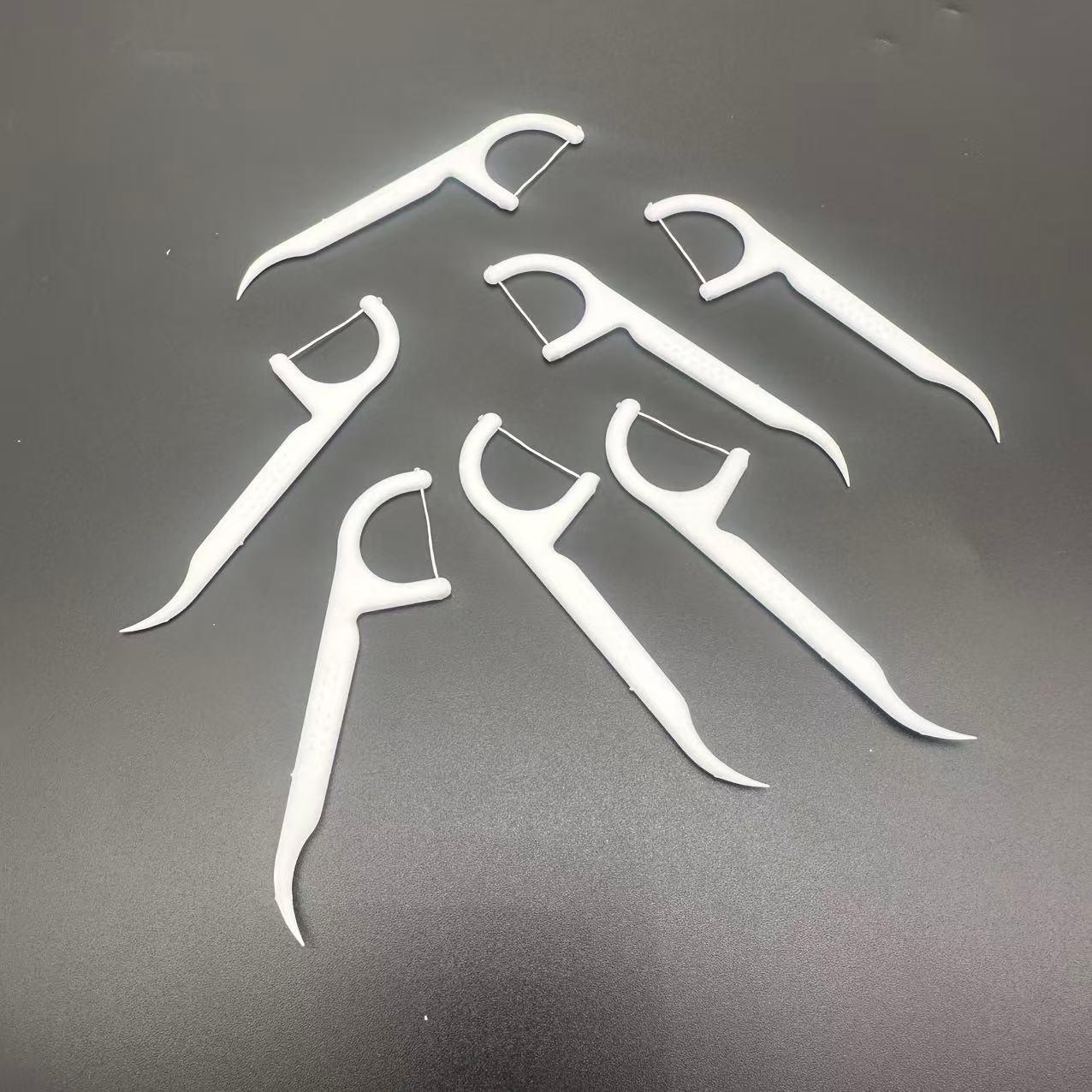
The everyday feel of floss often comes down to whether the strand is a monofilament or a bundle of nylon filaments. A single-strand PTFE floss slides through tight contacts with almost no drag, which reduces gum irritation but can feel slippery and less controlled. Multifilament nylon, especially when waxed, gives more friction and a slight texture that many people read as tactile feedback. That friction is a material choice, not an accident: it affects how firmly the floss grips the finger, how predictably it hugs a curved root, and how likely it is to shred on a rough filling.
Coatings and thickness change comfort in quieter ways. A microcrystalline wax finish smooths the outer filaments without making the floss feel greasy, while a beeswax or plant-based coating tends to feel softer against the gumline but fades faster during use. Thickness interacts with stiffness more than people expect. An ultra-thin polymer tape can flatten against the side of a tooth and slip below the gumline without snapping, whereas a thicker spongy floss feels gentle but may bind in crowded contacts. The right match depends on whether your priority is low friction, durability, or a softer touch.
Over time, the wrong material does more than annoy the gums; it quietly trims the routine. Floss that frays by the third tooth or leaves a waxy film on the fingers encourages people to skip the tightest spots. A strand that flexes rather than fights the contact point tends to make the whole routine feel less like a test of patience. In tight contacts, a smooth monofilament can be the least punishing option; with wider gaps and tender gums, a lightly waxed woven nylon often feels more comfortable. Comfort here is engineered through tensile strength, elasticity, and coating wear far more than through flavor or packaging.
What Consistency Looks Like on the Production Line
Walk through most assembly areas and you will hear the word “consistency” more often than any other. It shows up in the spacing between fixtures, the angle of a scanner mounted on a bracket, the way a torque tool is returned to its holder. These details rarely make it into a work instruction, but operators notice when they drift. A shift that starts with a misplaced tray or a different cable routing can spend the first twenty minutes fighting small frictions instead of building the product.
The clearest sign of consistency is not a perfect audit score. It is the absence of small negotiations. When a line is consistent, a new operator can step into a station and reach for the same part without looking at a diagram. A quality technician can spot a process deviation from across the aisle because the normal rhythm is so familiar. In practice, consistency means the shadow board matches the actual tools in use, the right-sized containers sit where the takt time expects them, and the person who rotates through on Friday does not have to invent a workaround.
This kind of stability usually comes from repetition with feedback rather than from a one-time cleanup event. Teams that hold a short end-of-shift reset, walk the line with a camera, or ask operators to mark anything that felt awkward during the run will find that consistency grows from dozens of small corrections. Over time, the line itself starts to teach the standard back to anyone who steps onto it.
Customization That Keeps Your Brand Voice Clear
Most customization tools flatten your tone until every message sounds like it came from the same forgettable chatbot. That is exactly what we avoid. We start by mapping the way your team actually talks—whether that is dry and precise, warm and direct, or playful without drifting into gimmick territory—then turn those patterns into adjustable guardrails, not rigid scripts.
The result is a setup where product names, sentence rhythm, and even the small transitions between ideas stay recognizably yours. You can tighten a phrase for a technical update or loosen it for a launch announcement without losing the underlying voice. That flexibility matters because brand voice is not a single setting; it shifts with context while still sounding like the same person.
What often gets overlooked is how much consistency depends on restraint. Instead of collecting endless tone options, we focus on the few decisions that actually shape perception: how you address the reader, how you handle mistakes, and when a shorter sentence does more than a clever one. Keeping those choices visible during customization is what keeps the voice clear, even as the message changes.
Sustainability Practices Worth a Second Look
Some sustainability moves get plenty of attention—reusable bags, solar panels, plant-based diets—but there are quieter habits that can shift daily routines without much fanfare. Reconsidering how a workplace handles surplus materials, for example, often uncovers simple reuse loops that cost nothing and cut waste faster than a new green product launch. The real value usually sits in the details nobody photographs.
A second look at water use in small operations reveals patterns that big sustainability pledges tend to miss. Fixing a slow drip, adjusting rinse cycles, or capturing gray water for non-potable cleaning can outperform a stack of carbon-offset certificates. These fixes are unglamorous, hard to put on a banner, yet they keep giving long after the initial audit ends.
Community-level borrowing networks deserve more than a passing nod. Tool libraries, seed exchanges, and repair cafés extend product lifetimes in ways that recycling bins cannot. They also rebuild the informal knowledge that used to be passed between neighbors. That social durability is exactly the kind of overlooked practice worth bringing back into the conversation.
A Manufacturer Built to Scale With Your Product Line
Production capacity is treated as a moving target rather than a fixed contract. Floor layouts, tooling setups, and shift planning are shaped around the way your catalog actually behaves, so smaller batches stay cost-effective while higher-volume orders shift into dedicated cells without triggering a full re-quote or a new approval chain.
When a new SKU is introduced, the engineering side starts from your existing drawings, samples, and test data. Fixtures, assembly steps, and inspection points are adapted around that product instead of forcing the product into a standard process. That removes much of the friction that usually appears between a working prototype and repeatable production.
What comes out of that approach is room to widen the line, adjust order sizes, or add variants without renegotiating the relationship. The manufacturing setup follows the product range instead of asking the product range to shrink to fit the plant.
FAQ
It usually comes down to the feel in the hand and the glide between teeth. Premium versions tend to use high-tenacity polymer monofilament that resists fraying, paired with a slightly textured handle that stays secure when wet. Tighter tolerances on the mold also mean fewer sharp edges around the pick tip, so it cleans effectively without irritating gums.
Look past the glossy brochure and ask about batch-level traceability. A dependable partner should track raw resin lots, mold cavity numbers, and inline tension checks. It helps to request retain samples from recent production runs and ask how they handle a failed lot, because that reveals whether their process is genuinely locked down or just written down.
ISO 13485 is the strongest signal for medical-grade quality systems, but for most floss picks ISO 9001 plus FDA device listing or EU CE marking may be enough depending on the market. Also ask for biocompatibility testing on the floss material and food-safe documentation for any added coatings or colors.
Yes, if they choose a factory that already has multiple handle molds and is willing to do cavity-level changes rather than full tooling from scratch. That might mean custom colors, logo embossing, or a different pick shape using an existing base. Full custom tooling is still expensive, but many manufacturers now offer hybrid programs to keep entry costs manageable.
There is a clear push toward plant-based or recycled handle materials, although the floss itself often still needs a synthetic core for strength. Thinner, wider ribbon-style floss is gaining popularity for comfort, and brands are moving away from heavy plastic clamshells toward paper-based or refillable packaging.
Cheap unit pricing rarely covers supply reliability. Ask about raw material sourcing, backup molds, and whether they keep safety stock of your finished SKUs. A slightly higher price can be worth it if the factory can guarantee production slots during peak seasons and maintain color consistency across runs.
Be cautious if they promise very low minimums without explaining how tooling is amortized, or if they avoid sharing sub-supplier names for floss and resins. Also watch for vague answers about tolerance limits and no clear procedure for mold maintenance, because those issues show up later as sharp edges, loose floss, or high breakage rates.
Conclusion
Premium floss picks rarely earn that label through a single feature. The difference starts in small, often overlooked choices: tapered floss that slides cleanly between tight contacts instead of snapping, a pick tip angled to reach without bending, and a grip that stays stable when hands are wet. Skilled manufacturers treat those details as baseline requirements, not upgrades. They test raw polymer blends for stiffness and flex, match floss coatings to glide rather than waxiness, and reject batches where the floss frays or the pick tip dulls after minimal use. That discipline carries onto the production line, where consistent tension, clean molding, and uniform packaging signal a partner that understands premium is a repeatable standard, not a lucky batch.
The right partner also gives a brand room to sound like itself. Whether you need a compact handle shape, a specific monofilament texture, or packaging that fits a subscription box, customization should go beyond printing a logo on a generic product. It means co-developing profiles, colorways, and even material stories your customers can feel and see. Sustainability adds another layer: recycled or bio-based resins, plastic-reduced packaging, and suppliers that can document their sourcing without making vague claims. Scale is the quiet test. A manufacturer worth keeping is one that can move from a first pilot run to high-volume orders without letting tolerances drift, so your best-selling floss pick stays as refined at the hundred-thousandth unit as it was at the hundredth.
Contact Us
Contact Person: Caiju Zhang
Email: [email protected]
Tel/WhatsApp: +86 14763963294
Website: https://www.kldbrush.com